
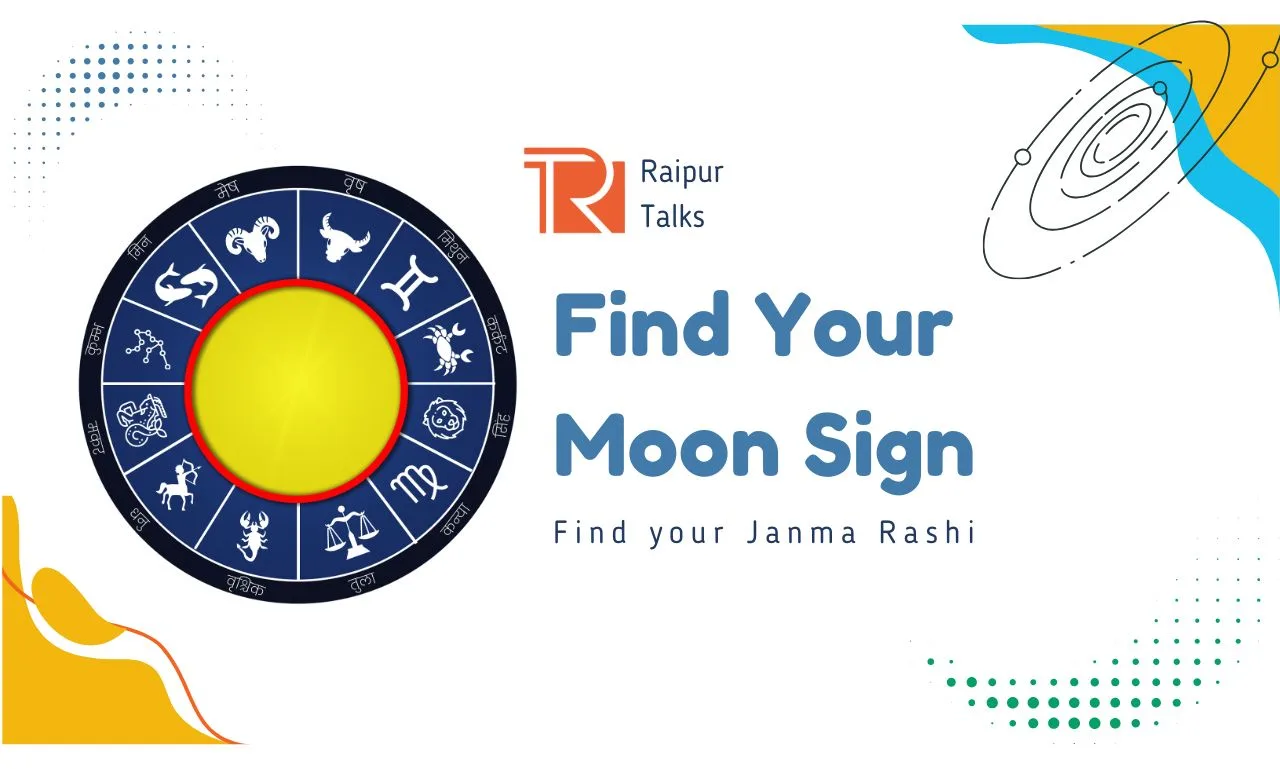
Most people ask this question at least once: what is my rashi? Maybe an elder asked for it before a wedding match. Maybe you saw “Mesh,” “Vrishabha,” or “Mithun” written somewhere and had no idea which one was yours. Either way, the rashi calculator above this article will give you the answer in a few seconds, using only your date of birth, time of birth, and birthplace.
But a calculator that just spits out one word isn’t very useful on its own. So this guide covers everything around it: what a moon sign actually is, how the calculation works behind the scenes, what each rashi means for your personality, and the questions people usually ask right after they get their result.
What Is a Rashi (Moon Sign)?
In Vedic astrology, your rashi is the zodiac sign the Moon was passing through at the exact moment you were born. It’s also called your Janma Rashi or Chandra Rashi. People often shorten it to just “moon sign.”
This is different from what most people know from newspaper horoscopes. Western astrology uses your Sun sign, based on where the Sun was on your birth date. Vedic astrology gives more weight to the Moon, because the Moon governs the mind, emotions, and how you instinctively react to situations. The Sun tells you about your core identity. The Moon tells you how you actually feel and behave day to day.
There are 12 rashis in total, and each one belongs to 30 degrees of the zodiac belt. Since the Moon moves fast, roughly one sign every two and a quarter days, your rashi depends heavily on your exact birth time. Two people born on the same date, a few hours apart, can end up with two different rashis.
Rashi vs Sun Sign: What’s the Real Difference?
This trips a lot of people up, so it’s worth spelling out clearly.
Your Sun sign changes once a month and stays fixed to the calendar date, which is why Western horoscope columns can print generic dates like “Leo: July 23 to August 22.” Your rashi, on the other hand, depends on where the Moon was, and the Moon shifts signs every two to three days. There’s no fixed date range you can memorize for your rashi. That’s exactly why you need a calculator, not a printed table, to find it accurately.
If someone asks you “what’s your sign” in the Western sense, they usually mean Sun sign. If a pandit or an elder asks “aapki rashi kya hai,” they mean the Moon sign. Both are real, both matter in their own systems, but they are not the same thing.
How Does a Rashi Calculator Actually Work?
Behind the simple form (date, time, place), a fair amount of astronomy is running.
1. It finds your exact birth coordinates. Your birth city gets converted into latitude and longitude, because the sky looks slightly different depending on where you’re standing on Earth.
2. It calculates the Moon’s longitude at your birth moment. Using your birth date and time, the calculator works out precisely where the Moon sat in the 360-degree zodiac belt at that second.
3. It applies Ayanamsha. This is the part most calculators skip explaining. Western astrology uses the Tropical zodiac, fixed to the seasons. Vedic astrology uses the Sidereal zodiac, fixed to the actual visible constellations. Over centuries, these two have drifted apart by roughly 24 degrees. Ayanamsha is the correction applied to shift from Tropical to Sidereal. Most Indian astrologers use the Lahiri Ayanamsha, though you’ll also see Raman and Krishnamurti (KP) versions on some sites, which can occasionally shift the result if your Moon sits right at the edge of two signs.
4. It maps the final degree to one of the 12 rashis. Once the sidereal Moon position is known, the calculator simply checks which 30-degree slice it falls into and names the rashi.
Everything above happens automatically the moment you hit submit on the calculator. You don’t need to understand Ayanamsha to use it. It just helps to know why two calculators might occasionally disagree by one sign, usually near a birth time close to a sign change.
How to Find Your Rashi (Step by Step)
- Scroll up to the calculator and enter your full name (optional, just for the display).
- Select your exact date of birth.
- Enter your birth time as precisely as you can, down to the minute if possible.
- Type your birth city. This fills in the location coordinates automatically.
- Hit submit. Your rashi, along with your ruling planet and nakshatra, will show up instantly.
A quick but important note: birth time accuracy matters more than people expect. If your birth certificate says 11:58 PM and the family memory says “around midnight,” that few-minute gap can occasionally change your rashi if the Moon was crossing signs right around then. If you’re unsure of your exact time, check your birth certificate or hospital records before relying on the result for anything serious, like a marriage match.
The 12 Rashis: Full List with Lord and Traits
| Rashi (Hindi) | English Name | Symbol | Ruling Planet | Element |
|---|---|---|---|---|
| Mesh | Aries | Ram | Mars | Fire |
| Vrishabha | Taurus | Bull | Venus | Earth |
| Mithun | Gemini | Twins | Mercury | Air |
| Karka | Cancer | Crab | Moon | Water |
| Simha | Leo | Lion | Sun | Fire |
| Kanya | Virgo | Maiden | Mercury | Earth |
| Tula | Libra | Scales | Venus | Air |
| Vrishchika | Scorpio | Scorpion | Mars | Water |
| Dhanu | Sagittarius | Archer | Jupiter | Fire |
| Makara | Capricorn | Sea-goat | Saturn | Earth |
| Kumbha | Aquarius | Water-bearer | Saturn | Air |
| Meena | Pisces | Fish | Jupiter | Water |
Notice there’s no fixed date column here, unlike what some sites print. That’s on purpose. As explained above, rashi dates shift every year depending on the Moon’s exact movement, so a static table would mislead more people than it helps.
What Each Rashi Says About Your Mind and Emotions
Since the Moon governs mental nature, here’s a plain-language look at what each rashi tends to reflect. Keep in mind, this describes general tendencies. Your full birth chart, including other planets, gives a much fuller picture.
Mesh (Aries): Quick to react, impatient with delays, and drawn to new things before finishing old ones. Learns by jumping in rather than reading the manual first.
Vrishabha (Taurus): This is where the Moon is considered exalted, meaning it’s in its strongest position. People with this rashi tend to be emotionally steady, comfort-seeking, and slow to change their mind once it’s made up.
Mithun (Gemini): The mind runs in two directions at once here. Curious, talkative, good at switching topics, but can struggle to settle on one thing for too long.
Karka (Cancer): This is the Moon’s own sign, so it feels natural here. Strongly attached to family, home, and the people who raised them. Feelings run deep, sometimes deeper than they let on.
Simha (Leo): Confident, wants to lead rather than follow, and cares about how they’re seen. Warm to people who respect them, cold to those who don’t.
Kanya (Virgo): Detail-oriented and practical, sometimes to the point of overthinking small things. Trusts what can be measured or proven more than what can’t.
Tula (Libra): Seeks balance and fairness, often weighing both sides before deciding anything. Uncomfortable with conflict, sometimes to a fault.
Vrishchika (Scorpio): This is where the Moon is considered weakest. Emotions here can swing hard depending on other planetary influences, moving between intensity and withdrawal.
Dhanu (Sagittarius): Drawn toward philosophy, faith, or a bigger sense of meaning. Honest, sometimes too blunt, and restless if life feels too small.
Makara (Capricorn): Serious-minded and disciplined, with a strong sense of duty. Takes time to open up emotionally, and once a view is formed, it doesn’t move easily.
Kumbha (Aquarius): Social in an unconventional way, more interested in groups and causes than one-on-one closeness. Independent thinker, sometimes detached from their own feelings.
Meena (Pisces): Sensitive, imaginative, and drawn to spiritual or artistic pursuits. Absorbs the moods of people around them more than most other signs.
Rashi, Nakshatra, and Lagna: Clearing the Confusion
These three terms get mixed up constantly, so here’s the short version.
Rashi is the zodiac sign of the Moon, one of 12 possible signs, each 30 degrees wide.
Nakshatra is a finer, more precise division. There are 27 nakshatras (lunar mansions), each about 13°20′ wide. Every rashi actually contains parts of more than one nakshatra. So your rashi tells you the broad emotional sign, while your nakshatra gets much more specific about personality and timing.
Lagna, also called the Ascendant, is the zodiac sign that was rising on the eastern horizon at your exact birth moment. This depends entirely on birth time and location, changing roughly every two hours. Lagna is considered the foundation of your whole birth chart, more important than rashi for many predictive purposes.
If you want the complete picture, you generally need all three: rashi for your mind, nakshatra for finer traits and muhurat timing, and lagna for your overall life chart.
Why Knowing Your Rashi Actually Matters
- Marriage matching (Kundali Milan): Rashi and nakshatra compatibility form a core part of the traditional Ashtakoot matching system used before Hindu weddings.
- Daily and monthly predictions (Rashifal): Most horoscope columns and rashifal apps are based on your Moon sign, not your Sun sign, which is why Vedic rashifal often feels more accurate to people than Western horoscopes.
- Naming ceremonies: In many families, the first letter of a baby’s name is chosen based on the nakshatra pada linked to their rashi.
- Muhurat and timing decisions: Auspicious dates for weddings, griha pravesh, or other events are often checked against the person’s rashi and current planetary transits (gochar).
- Self-understanding: Even without any religious angle, a lot of people just find it useful as a lens to think about their own emotional patterns.
FAQs
Is rashi the same as zodiac sign?
Yes, but with a difference in system. When most Indians say “rashi,” they mean the Vedic sidereal zodiac sign of the Moon. When Western sources say “zodiac sign,” they usually mean the tropical Sun sign. Same idea, different math.
Can two people born on the same day have different rashis?
Yes. Since the Moon changes signs roughly every 2 to 3 days, and can shift even within a single day near a sign boundary, two people born hours apart, even on the same date, can end up with different rashis.
What if I don’t know my exact birth time?
Try to find your birth certificate or hospital discharge papers first, since they usually list the exact time. If that’s truly unavailable, some astrologers can estimate your rashi using other life events through a method called rectification, but this isn’t as reliable as an exact birth time.
Which Ayanamsha should I use?
Lahiri Ayanamsha is the most widely accepted standard in India and is used by the Indian government’s own Rashtriya Panchang. Stick with it unless a specific astrologer you follow asks you to use a different one.
Is rashi the same as Nakshatra?
No. Rashi is one of 12 broad zodiac signs. Nakshatra is one of 27 narrower lunar mansions. Every rashi is made up of parts of two or three nakshatras.
Does rashi decide my whole personality?
No single factor does. Rashi mainly reflects your mind and emotional nature. Your full personality in Vedic astrology comes from your entire birth chart, including your Lagna, the placement of all nine planets, and the houses they sit in.
Final Word
Your rashi is a small but meaningful piece of information, easy to find once you have your correct birth date, time, and place ready. Use the calculator above to get your exact Moon sign, and keep this guide handy if you ever need to explain the difference between your rashi, your nakshatra, and your lagna to someone at the next family gathering.